
SEO for English-speaking businesses in Spain.
01 / The basics
Start with the way your customers actually search.
Running an English-speaking business in Spain puts you in an unusual market. Your customers may live five minutes away, own a holiday home they visit three times a year, or still be sitting in Britain, Ireland, Germany or Scandinavia planning their move.
They may search in English, Spanish or a mixture of both. They may type the name of a town without the accent, search for a service “near me” or go straight to Google Maps. A sensible SEO strategy has to reflect how these people actually behave, not how an SEO DIY guide says they should behave.
You do not need thousands of pages full of repeated place names. You need a clear site and useful evidence showing what you do, where you work and who you help.
02 / Search language
English vs Spanish keyword targeting in Spain.
Good SEO starts with a simple question: what would a genuine customer search for?
An English-speaking electrician in Marbella may need to be found for “electrician Marbella”, “English-speaking electrician Marbella” and “emergency electrician near me”. A gestor may need pages about the individual problems people want solved rather than one vague page headed “Our Services”.
Each important service should have enough information to stand on its own. Explain what is included, the area covered and what someone should do next. Add real photographs, reviews, qualifications and examples. These details help Google understand the business and help a customer decide whether to call.
SEO is not simply adding keywords after a website has been built. Its structure, page speed, mobile layout, headings, internal links and contact journey all matter. Our approach to SEO for small businesses in Spain brings those parts together instead of treating them as separate jobs.
03 / Multilingual SEO
Multilingual SEO for English and Spanish websites.
A bilingual website should not place two languages in alternating paragraphs on the same page. Give English and Spanish their own URLs, such as `/en/service/` and `/es/servicio/`, with a visible language switcher.
The Spanish copy should read as though it was written for a Spanish customer, not fed through an automatic translator. Prices, examples, calls to action, and even the questions answered may need to change. Use `hreflang` tags to connect equivalent pages so Google can show the appropriate language version. Google’s guidance on localised pages explains how these tags work.
A smaller number of accurate Spanish pages is better than a complete translation that becomes outdated or sounds unnatural.
04 / Domain names
Should a Spanish business website be .es or .com?
Either can work. A `.es` domain sends a clear signal that the website targets Spain. A `.com` is more neutral and can suit a business serving customers in Spain and people overseas. Google treats country-code domains such as `.es` as a strong country signal, as explained in its guidance for multi-regional websites.
That does not mean a `.es` automatically outranks a `.com` in Spain. An established `.com` with Spanish contact details, local content, links, reviews and a properly managed Business Profile can perform extremely well. Choose the domain customers will remember and trust. Do not move an established website simply because somebody says another extension is “better for SEO”.

05 / Google Maps
How to rank a business on Google Maps in Spain.
Nobody can guarantee a top-three Maps position. Google says local results are mainly based on relevance, distance and prominence. Its local ranking guidance is worth reading before paying for a ‘guaranteed’ number-one listing.
The practical work is straightforward, although it takes consistency:
Choose the most accurate primary business category.
– Complete the services, hours, telephone number and website fields.
– Write a clear description without stuffing it with town names.
– Add genuine, recent photographs of the business and its work.
– Ask real customers for reviews and reply to them naturally.
– Keep the business name, address and contact details consistent online.
– Link the profile to a useful local page, not a thin doorway page.
Reviews matter, but buying them or asking everyone to repeat a keyword is a bad idea. A steady flow of honest reviews is more convincing to customers and safer for the business.
06 / Service areas
Google Business Profile optimisation for service-area businesses in Spain.
Plumbers, electricians, cleaners, property-care companies and mobile technicians often visit customers rather than receive them at an office. They can use a service-area Business Profile. If customers do not visit the registered address, hide the address and select genuine service areas instead.
Do not create a false office in every Costa del Sol town. A virtual office or borrowed address does not make a business local and can lead to suspension. One accurate profile, supported by strong service and location information on the website, is far more valuable than a collection of risky listings.
Service areas should be realistic. Saying “all of Spain” is unhelpful if the team works between Málaga and Estepona. Clear coverage also prevents wasted calls.
07 / Tradespeople
Website design for tradespeople on the Costa del Sol.
A tradesperson’s website has one practical job: turn a search into an enquiry. On a phone, visitors should immediately see the trade, service area, contact button and a reason to trust the business.
Avoid slow opening animations, vague stock photographs and long introductions about “quality solutions”. Show real work. Explain emergency availability honestly. List core services and towns without pretending to have an office in each one. Qualifications, insurance, reviews and clear before-and-after examples can do more work than an elaborate design.
Good website design for businesses in Spain should still have character, but it must make calling, messaging or requesting a quote easy.
08 / Property management
SEO for property managers in Marbella.
Property management is a crowded phrase. One company may manage holiday rentals; another may provide keyholding, inspections and maintenance for non-rental homes. The website must make that difference clear.
Useful pages can answer the questions overseas owners actually ask: how inspections work, what happens after storm damage, who holds the keys, how maintenance is approved and which areas are covered. A page about looking after an empty villa in Marbella is likely to attract a more suitable customer than a generic page repeating “best property management company”.
Trust is crucial. Introduce the people doing the visits, use original photographs, explain reporting procedures and show reviews. The customer is handing over access to a valuable home; polished claims alone will not reassure them.
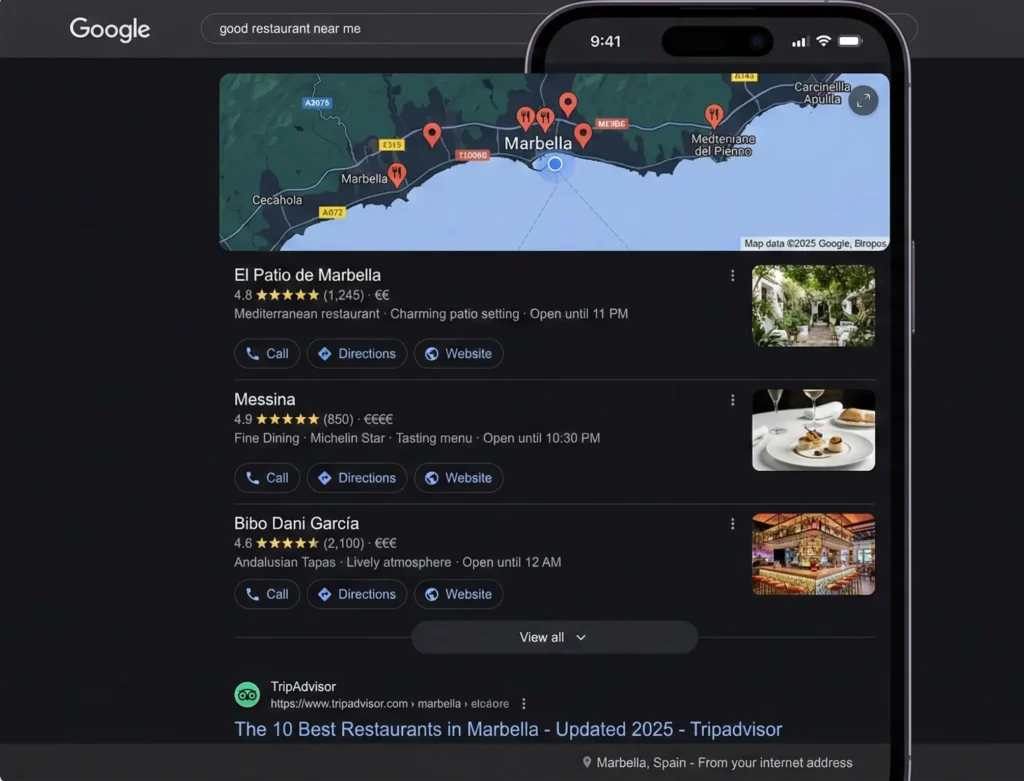
09 / Restaurants
SEO for restaurants targeting tourists on the Costa del Sol.
Tourists search differently from residents. They may look for “ecological restaurant Benalmádena marina“, “Sunday roast near me”, “gluten-free restaurant Fuengirola” or somewhere serving food late after a flight.
A restaurant website should make the menu, location, opening hours, booking method and dietary information easy to find on a phone. Keep Google hours updated for holidays and upload current food and exterior photographs. English can target tourists, while a well-written Spanish page serves local customers.
Do not hide the menu inside an enormous PDF. An accessible webpage is easier for customers and gives search engines much more useful information about the cuisine, dishes and prices.
10 / Estate agents
Local SEO for estate agents in Marbella.
Estate agents face some of the strongest search competition in southern Spain. Copying the same property feed as dozens of other websites will not create much reason for Google, or a buyer, to choose yours.
Original area guides, buying advice and well-written property descriptions provide something more useful. A Nueva Andalucía guide should demonstrate genuine knowledge of that area: property types, everyday facilities, access, lifestyle and the questions buyers regularly ask. It should not be the Marbella page with the place name changed.
Sold, duplicated, and filtered property URLs can create thousands of weak pages. Useful indexable pages need deliberate titles, internal links and current content; low-value search combinations should be controlled.
11 / Bringing it together
A website should bring all the pieces together.
For English-speaking businesses operating in Spain, local SEO is not about choosing English or Spanish, Google Maps or the website, design or content. The right balance depends on the service, location and customer.
Start by being precise. Say what you do, where you genuinely work and which languages customers can use. Build helpful pages around real services and questions. Keep your Google Business Profile accurate. Then make it very easy for somebody to contact a real person.
That may sound less exciting than a secret ranking trick, but it is much more likely to build lasting visibility and bring the right enquiries.
For a free local SEO quote, contact us below.